Shibuya, Tokyo
Shibuya Underfoot: Buried Rivers, Planted Woods, Borrowed Names
A walk through Shibuya's planted forest, the buried Udagawa, Hachikō's melted-down statue and the shrine that gave the ward its name.
Published 30 sources
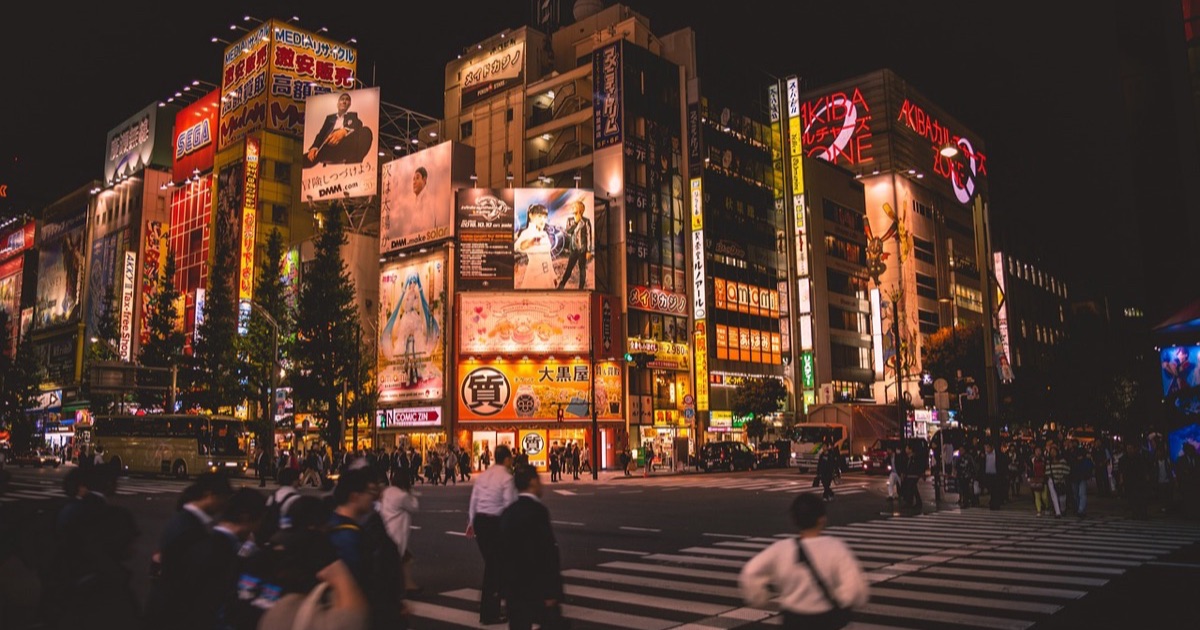
Shibuya Station opened in 1885, with the opening of the Nippon Railway Shinagawa Line — the route now called the Yamanote Line. The station building then was a small wooden structure. In 1927 the Tokyo-Yokohama Electric Railway, today's Tokyu Toyoko Line, extended its service here to an elevated station with one island platform and two tracks, widened in stages later. Stand in the concourse crush now, under line after line of gates and stairs, and that single platform is the harder thing to believe.
Almost everyone arranges to meet at the dog. Hachikō was an Akita, born in Ōdate in Akita Prefecture in November 1923 and kept by Hidesaburō Ueno, a professor at Tokyo Imperial University. Ueno died suddenly in May 1925, and for nine years after that the dog kept coming to Shibuya Station, until he died of illness in front of it in March 1935, aged 13. His remains are kept at the National Museum of Nature and Science.
The bronze beside the station is a replacement. The original, by the sculptor Teru Andō (安藤照), was unveiled on April 21, 1934, and melted down in 1944 under the wartime metal-collection order. The figure standing there now is by the sculptor's son, Takeshi Andō (安藤士), unveiled on August 15, 1948. The most ordinary meeting point in the city spent some years not existing at all.
The Shrine Where the Word Shibuya Starts
The word Shibuya has a shrine behind it. Konno Hachimangū (金王八幡宮) is a Shinto shrine — a walled precinct of trees and wooden halls holding the deity of a locality — and tradition places its founding in 1092, when the warrior Minamoto no Yoshiie (源義家) took his victory in the war remembered as Gosannen no Eki (後三年の役) as proof of protection by the Hachiman deity worshipped by Kawasaki Motoie (河崎基家), and had a Hachiman shrine invoked here. The shrine's own history carries it further: Kawasaki Shigeie (河崎重家), ancestor of the Shibuya clan, was granted the surname Shibuya by Emperor Horikawa for putting down thieves in the imperial palace, and set his residence around the shrine.
The shrine's own name came from a child. The story goes that Shibuya Heizō Shigeie (渋谷平三重家) and his wife prayed here, and that she dreamed the Buddhist deity Kongō Yaksha Myōō (金剛夜叉明王) had come to dwell in her womb; their son, born in 1141, was named Kin'ōmaru from the upper and lower characters of the deity's name, and by that telling his name passed to the shrine. The hall in front of you is explained by the shrine as work of 1612, raised in the gongen-zukuri style of shrine architecture by the Tokugawa retainer Aoyama Tadatoshi (青山忠俊) and Kasuga no Tsubone (春日局) under the second shogun, Hidetada. Shibuya Ward designates it a cultural property.
One thing kept here belongs to a neighbourhood on the far side of the ward. Shibuya Ward's notes on place names pass on a story that Hatagaya (幡ヶ谷) was named for a pond where Minamoto no Yoshiie washed a white flag as he travelled up to the capital after that same war. The pond was filled in in 1963; the flag, by that account, came down as a treasure of Konno Hachimangū. A vanished pond, tied to this precinct by a piece of cloth.
Further back than that, the name is unsettled. The Shibuya Ward Library sets several accounts side by side: that a village of salt-burning became Shioya-no-sato and Shihoya slid into Shibuya; that the lord Kawasaki Heizō Shigeie was granted the surname in the late Heian period and the land took it from him; that a clan moved here from Shibuya Manor in Kōza District, Sagami Province, in the Jishō years of 1177 to 1180 and brought the name along; and that the Shibuya River ran rust-red with iron. The river is still there to look at.
The shrine explains that its largest festival of the year falls around September 14, over a parish covering Shibuya and Aoyama. On the Sunday afternoon, mikoshi — portable shrines carried on the shoulders of a neighbourhood — come from each local association and gather in front of SHIBUYA109 on Dōgenzaka for a joint procession, while the Aoyama side carries its own along Aoyama-dōri. Stalls fill the precinct, and satokagura, folk Shinto music and dance, is offered at the kagura hall.
What the Ground Remembers
Shibuya Center-gai tells its own history as a story about water: the Udagawa (宇田川), which once joined the Shibuya River, ran through here and flooded the place whenever rain came hard, and land readjustment put the channel underground and made the strip a nightlife quarter called Udagawa Yurakugai, before the Shibuya Center merchants' association was formed in 1961. Shinsen (神泉) was named by water too — the ward's account says a sacred spring here flourished as Kōbōyu (弘法湯) from the Edo period until around the 20th year of Meiji, and that the Edo-period geography Edo Sunago (江戸砂子) sets it down. The crowd you are standing in is standing on a river.
Two more names point at the ground itself. Tomigaya (富ヶ谷) was once written Tomegai (留貝), and the ward traces the word to a layer of shell fossils some 10 meters below the surface. For Sendagaya (千駄ヶ谷), an old gazetteer of Musashi province describes thatch grass over the upper valley of the Shibuya River, where in the Kan'ei years so much was cut daily that the place became Sendagaya written with the character for thatch — senda (千駄) in the sense of a very large quantity — and a record of 1644 uses that spelling. Another telling credits the warlord Ōta Dōkan (太田道灌), said to have named it from the valley's rice yield.
Other districts keep the habit. Hiroo (広尾) was open country called Tsukushi-ga-hara (土筆ヶ原), thick with horsetail shoots, the ward's portal explains, and passed through Hirono (広野) before the characters now read as Hiroo came into use around the Genroku land survey. Shōtō (松濤), the ward's site adds, held a secondary residence of the Kii branch of the Tokugawa family in the Edo period; in the early Meiji years the Nabeshima family grew Sayama tea there and opened a garden called Shōtō-en (松濤園), whose name became the district's in 1928.
Up Dōgenzaka, Down Spain Slope
Dōgenzaka (道玄坂) has an unsavoury namesake. The ward's place-name notes carry a tradition that Ōwada Tarō Dōgen (大和田太郎道玄), a survivor of Wada Yoshimori's broken force, worked this slope as a bandit after the Shibuya clan fell, and that the name is his. A competing explanation points instead to a temple called Dōgen-an (道玄庵), which appears in the record known as the Tenshō Nikki (天正日記). Climb with whichever story you prefer.
SHIBUYA109 stands on Dōgenzaka, and its name is a pun. The operator, Tokyu (東急), can be read as tō — ten — and kyū, nine: 10 and 9 on the sign. The building's official name is the Dōgenzaka Kyōdō Building (道玄坂共同ビル), and it belongs to Tokyu Malls Development (東急モールズデベロップメント), a wholly owned subsidiary of Tokyu Railway. A fair thing to ask whoever you are walking with, since the answer is on the building.
Supein-zaka (スペイン坂), Spain Slope, got its name from a café. Parco, which opened in Shibuya in 1973, asked the owner of a coffee shop along the slope — its interior done in Spanish style — to name the hill, and he named it after the mood of his own room. The buildings around it were then given southern European faces to match. Here the townscape followed the name rather than the other way round.
Center-gai also named a sound. HMV Shibuya opened there in 1990, and from around 1991 the Japanese records it sold stopped tracking the enka charts — the older ballad business — so the store built a section of its own, SHIBUYA RECOMMENDATION, for the customers it actually had. Who first said Shibuya-kei (渋谷系) is not agreed: one account has the shop's Japanese-music buyer using it in conversation, another has it appearing around 1993, when an editor from the magazine apo came to report on the store.
Bunkamura took its name from a plan. On October 16, 1984, Tokyu Department Store led the announcement of a redevelopment scheme called Shibuya Plan 1985, which contained a "culture village" concept. The name Bunkamura was settled on November 16, 1988; construction had started on June 25, 1986; and on September 3, 1989 the complex opened with a concert hall, a theatre, an art museum and a cinema inside it. A working title that stayed on the door.
When the Platform Grew a Department Store
On November 1, 1934 a department store opened connected to the end of the Toyoko Line platforms at Shibuya: the Toyoko Department Store, the earliest terminal department store in the Kantō region run directly by a private railway. Employees who had gone to study how Hankyu Department Store was managed are described as leading the work, assembling the business from nothing. Station and shop as a single structure, bolted together here.
On December 1, 1956 the Shibuya Tokyu Bunka Kaikan opened at the station's east exit: one basement floor and eight above, about 30,000 square meters, holding four cinemas, a planetarium and other cultural rooms. The Goto Planetarium began running in April 1957, able to throw as many as 9,000 stars onto a sphere, in the same year the Soviet Union sent the unmanned satellite Sputnik 1 into space and a boom in all things cosmic followed; its audiences ran far beyond those of other planetariums of the day. Shibuya Hikarie (渋谷ヒカリエ) holds the ground now, and the stars were upstairs.
A Planted Wood, a Drill Field, a Hanging Roof
The wood around the main hall of Meiji Shrine (明治神宮) reads as old forest and is not. It is planted: at the shrine's founding, trees donated from every part of the country were set out across this ground, with the aim of raising what its makers called an eternal forest. Walking the approach among trunks that look as though they were always there, the thing to hold onto is that every one of them arrived as a gift from somewhere else.
The lawn of Yoyogi Park (代々木公園) has had other lives. Before the war and until the war's end this was an army drill field. Afterwards it became Washington Heights, housing for the American military. Part of it served as the Yoyogi Olympic Village for the 1964 Tokyo Olympics, and after redevelopment it opened as Yoyogi Park in 1967. Drill ground, foreign suburb, athletes' village, grass.
The Yoyogi National Gymnasium (国立代々木競技場) occupies part of the same stretch of land. It was designed for the 1964 Tokyo Olympics by Kenzō Tange (丹下健三), Masakatsu Tsuboi (坪井善勝) and Uichi Inoue (井上宇市), and its long curved roof is not propped up but hung — a suspension roof carried on wire ropes. One hall took the swimming and diving, the other the basketball. The design counts as representative Japanese architecture; from outside, look up at where the roof hangs from its ropes.
Harajuku: A Spire, a Crepe, a Parade
Until recently Harajuku Station (原宿駅) had a wooden building from 1924, half-timbered in the English manner with a spire on top, and it was the oldest wooden station building in Tokyo. Its 96 years ended in March 2020, and dismantling began that August. Around the present station, it is worth looking for whatever is left of that old shape.
Marion Crepes (マリオンクレープ) on Takeshita Street tells its beginnings plainly: the business started in 1976 in a corner of a parking lot on Shibuya Kōen-dōri, and wrapping a crepe in paper so it could be eaten on the move was, by the company's account, something not done in Japan before. The shop moved to Takeshita Street the following year, in 1977, and spread along with the street's culture, the Takenoko-zoku (竹の子族) dance groups among it.
The costumes at the Shibuya Scramble Crossing did not begin on their own. Newspaper records show that on October 31, 1987, shopping-street associations and companies around Ebisu and Daikanyama organised a costume parade in Shibuya Ward, with some 2,000 people expected. On October 31, 1993, a local shopping association's parade in Omotesandō drew about 3,000. On October 26, 1997, the Harajuku Champs-Élysées Association held the 17th of its Hello Halloween Pumpkin Parades, with about 2,000 taking part.
Out to Ebisu, Daikanyama and the Western Slopes
Ebisu (恵比寿) is named after a beer. A brewing company founded in 1887 put Ebisu Beer on sale in 1890, and in 1901 a station went in purely to ship it. The word became a place name only in 1928, when part of the town of Shibuya was renamed Ebisu-dōri 1 and 2 chōme. Product, then freight stop, then neighbourhood: a brand that worked its way onto the map.
Ebisu Yokocho (恵比寿横丁) sits on the site of the Yamashita Shopping Center (山下ショッピングセンター), a public market grown out of a postwar barracks market. The yokocho — a narrow lane of small places to eat and drink — opened on May 30, 2008 with 13 shops, and the official account gives the aim as more than laying out a dining strip: reviving the shopping district and growing a new eating-and-drinking culture. A market's ground, put back to its old use.
In Daikanyama, Hillside Terrace (代官山ヒルサイドテラス) was built slowly on purpose. Its official story records that the architect Fumihiko Maki (槇文彦) and his office designed it and that it went up in several phases between 1967 and 1992, with Hillside Plaza Hall finished in 1987 and Hillside Forum in 1992. The landowner, Asakura Fudōsan (朝倉不動産), wanted the place fitted gradually to a changing environment so it would stay comfortable over a long span. Walk its length and the phases show.
Sasazuka (笹塚) carries a name from the Kōshū Kaidō (甲州街道), the old highway west. Mounds stood on both sides of the road with bamboo grass growing thick over them, and the ward's notes hold that this is why the area came to be called Sasazuka; tradition puts the making of the mounds in 1604, by Ōkubo Nagayasu (大久保長安). By Sasazuka Station on the Keiō Line, the Jūgōzaka shopping street runs about 120 meters up a slope; one write-up of a walk there notes a patisserie founded in the Shōwa 30s that makes everything itself, including sweets carrying the names Sasazuka and Jūgōzaka.
Yoyogi-Hachiman, close to what people here call Oku-Shibuya, back Shibuya, has a bakery named 365 Nichi (365日). One food write-up records that its Sompurusan (ソンプルサン) is made with Honoka (穂香), a wheat flour from Hokkaidō, and with as much water as flour, which is where the chew comes from; the crumb is full of wide holes and has a moist, mochi-like quality in the mouth. Buy a loaf, walk back toward the noise with it under your arm, and the crossing arrives as the end of a long walk rather than the start of one.
Shibuya quiz
3 questionsQ1
How long did the Akita dog Hachikō (ハチ公), who kept waiting outside Shibuya Station, continue coming there after his owner’s sudden death?
Not quite. The answer is A: “About nine years”
Hachikō was an Akita dog born in Ōdate, Akita Prefecture, in November 1923 and was kept by Hidesaburō Ueno (上野英三郎), a professor at Tokyo Imperial University. After Ueno’s sudden death in May 1925, Hachikō continued waiting for his owner and died of illness outside Shibuya Station in March 1935, at age 13. His remains are preserved at the National Museum of Nature and Science. When you stand by the statue, remember those years.
Q2
What is the origin of “109” in SHIBUYA109?
Not quite. The answer is A: “A wordplay on the reading of the operator’s name, Tokyu (東急)”
According to the article, “109” is a play on the reading of the operator’s name, Tokyu (東急): 10 is read as “tō” and 9 as “kyū.” The building’s official name is the Dōgenzaka Kyōdō Building (道玄坂共同ビル), owned by Tokyu Malls Development (東急モールズデベロップメント), a Tokyu Railway subsidiary. Look up at the building at Dōgenzaka’s entrance and quiz your companions.
Q3
The roughly 700,000-square-meter forest surrounding the main hall of Meiji Shrine (明治神宮) — how was it created?
Not quite. The answer is A: “A planted forest grown from about 100,000 trees donated from across Japan”
The roughly 700,000-square-meter forest around Meiji Shrine (明治神宮) is a planted forest, created when about 100,000 trees donated from across Japan were planted at the shrine's founding with the aim of growing an "eternal forest." Each tree was placed by hand, one at a time. As you walk the approach, consider that this deep woodland was entirely man-made.
Sources
This article is based on the following sources (mostly in Japanese).
- 1.渋谷発展の歴史|渋谷再開発&まちづくり|東急株式会社
- 2.7:複数路線が集まる「渋谷駅」の発展 ~ 渋谷 | このまちアーカイブス
- 3.ハチ公について知りたい | 渋谷区立図書館
- 4.ご祈願・ご参拝|【金王八幡宮】
- 5.地名の由来 | 区の紹介 | 渋谷区ポータル
- 6.「渋谷」の名はどこからきたの ~渋谷の由来
- 7.ご祈願・ご参拝 年間行事 | 金王八幡宮
- 8.センター街データ | 渋谷センター街
- 9.渋谷の各地名の由来 千駄ヶ谷編
- 10.「渋谷109」名前の由来わかりますか? 渋谷駅周辺ビルの歴史を調べてみた
- 11.スペイン坂の名前の由来?ペンギン通り、オルガン坂、そしてまさか…渋谷の独特な名前の坂道
- 12.タワレコと渋谷と音楽の歴史〈90年代〉増え出した情報量
- 13.それでも渋谷は音楽の街。レアグルーヴの遺伝子は今も息づく|シブヤ文化漂流記
- 14.Bunkamuraの歴史 | 株式会社東急文化村
- 15.渋谷の「骨格」が消える ターミナルデパート「東急東横店」ヒストリー - シブヤ経済新聞
- 16.渋谷のシンボルが47年の歴史に幕 サヨナラ「渋谷東急文化会館」 - シブヤ経済新聞
- 17.明治神宮とは|明治神宮
- 18.代々木公園 公園の概要と戦前、戦後の歴史
- 19.国立屋内総合競技場(代々木競技場)|JOC 日本オリンピック委員会
- 20.原宿駅の旧駅舎 月内解体着手 都内最古の木造駅舎は建て替えへ | 乗りものニュース
- 21.原宿駅のシンボル「木造駅舎」が再現で復活へ - 鉄道コム
- 22.マリオンクレープの歴史 | MARION CREPES 公式
- 23.「渋谷ハロウィンは若者が勝手に集まった」は本当か? 過去の記録を調べてみると……
- 24.恵比寿(JY21): 「ビール」の商品名に由来する全国でも珍しい駅名
- 25.ブランドヒストリー | YEBISU
- 26.恵比寿東口のレトロ市場跡に「恵比寿横丁」-居酒屋など13店舗
- 27.恵比寿横丁 | 株式会社浜倉的商店製作所
- 28.ストーリー / HILLSIDE TERRACE
- 29.ササハタハツ散歩 No.11 笹塚十号坂商店街で、手土産にぴったりな「笹塚名物」を発見!
- 30.代々木八幡の人気パン屋「365日」のおすすめメニュー!店舗詳細や杉窪シェフが描く未来図なども
This article was put together with the help of AI from facts confirmed in its sources, and checked against those sources before publication. See our editorial policy for details.