Shinjuku, Tokyo
Shinjuku Layer by Layer: Post Station, Black Market, Towers
A walk across Shinjuku, from the Naitō Shinjuku post station and the Lucky Street black market to towers built on a closed water plant.
Published 34 sources
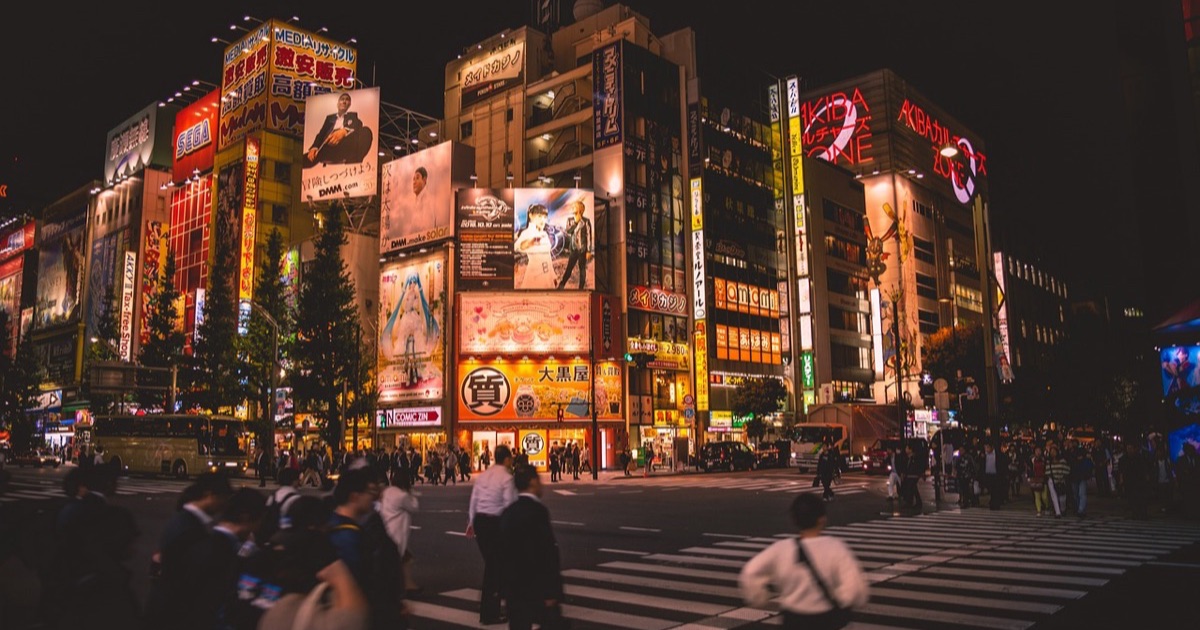
Begin at the ticket gates, because almost everyone else does. Guinness World Records recognizes Shinjuku Station (新宿駅) as the world's busiest railway station, on the basis of its average daily passenger figures for 2022 — a count that domestic coverage points out was still below pre-pandemic levels. Stand to one side of the concourse for a few minutes and the flow never actually stops; it only changes direction. Then take an exit, any exit, and walk out of it.
The name on the signs is a piece of road administration. Shinjuku City explains that the Kōshū Kaidō (甲州街道), whose starting point was Nihombashi, ran so far before reaching its first post station at Takaido that travelers suffered for it, and that a station was therefore permitted partway along. In 1697 Takamatsu Kihei, a headman from Asakusa, petitioned the shogunate together with four associates; the station opened in 1699 on part of the Naitō family's suburban residence, ground that lies north of Shinjuku Gyoen (新宿御苑) today. It was called Naitō Shinjuku — the family name plus the sense of "new post station" — and that is where the modern name comes from.
What the Kōshū Kaidō Left Behind
A post town needs a temple, and Taisōji (太宗寺) stood inside Naitō Shinjuku. In its grounds is a bronze seated figure of the bodhisattva Jizō, counted among the Edo Six Jizō and designated a tangible cultural property by the Tokyo Metropolitan Government. Because the temple sat on the highway, worshippers arrived in numbers and a town of shops grew up outside its gate. It is a quiet place now, and worth a stop in front of a statue that watched that many people set out.
Shinjuku Gyoen began as the same family's land. The Naitō were lords of the Takatō domain in Shinano, and their residence here held a garden called Tamagawa-en, completed in 1772 and open to the public, fed by surplus flow from the Tamagawa Josui waterway. After the Meiji Restoration the Ministry of Finance bought the site in 1872 and set up the Naitō-Shinjuku Experimental Station, an agricultural trial ground. The Imperial Household Ministry took it over in 1879 and renamed it the Botanical Gardens; a garden designed by a French engineer named Martinet was finished in 1906, making it the imperial garden Shinjuku Gyoen. It opened as a national park in 1949.
East of the garden, in Shinjuku Sanchōme, a different kind of import turns up. Nakamuraya's company history records that its Pure Indian Curry went on sale in 1927, built from a recipe proposed by Rash Behari Bose, an activist of the Indian independence movement who had been sheltered by the founders, Soma Aizō and Kokkō. What made it unfamiliar to Japanese diners was its shape: large pieces of chicken still on the bone, strongly fragrant spices, and white rice resembling indica rice.
Lucky Street, Seven Lanes, One Roar
On the west side of the station, Omoide Yokocho (新宿西口思い出横丁) keeps the footprint of something much rougher. The alley's official history records that around the 21st year of Shōwa, street traders and food stalls gathered on the burned ground near the west exit, forming the black market known as Lucky Street during the years of the controlled economy — the system of rationing and price control then in force. Around the 22nd year of Shōwa, tighter policing of controlled goods pushed more shops toward grilled offal. By the subway extension and redevelopment around the 34th year of Shōwa, some 300 shops had been reduced to the stretch from the Palette Building, the Shinjuku West Exit Hall, as far as the Ōme-kaidō.
Golden Gai (新宿ゴールデン街), across on the east side, came out of the same postwar rearrangement. Just after the end of the war in 1945, the black market that had stood east of Shinjuku Station was moved by the occupying forces into this block, then an open lot said to resemble a field of pampas grass. Until the anti-prostitution law came fully into force in 1958 the area worked as an unlicensed red-light quarter; afterwards it turned into a district of drinking places, and around 1970 writers, poets and other cultural figures began gathering in it.
The street plan is small enough to read in a single walk: six lanes running east to west and one crossing them north to south, seven in all. The quarter is divided between two trade bodies, the Shinjuku Sankō Shopping Street Promotion Association in the north and the Shinjuku Golden Gai Commercial Association in the south, a split that follows the different ways the two halves came into being. The old name for the whole block was Sankōchō. Counting the lanes as you go is a good way to notice how narrow each one is.
A few minutes away, Kabukichō (歌舞伎町) answers with something louder. On the roof of the Shinjuku Toho Building, above the cinema, sits a Godzilla head about 12 meters tall, which roars and lights up once an hour at set times. It has become the symbol of the quarter. The head can be seen from street level, so the game is working through the surrounding lanes until you find the angle you want.
The Shrines Kabukichō Grew Around
Hanazono Shrine (花園神社) stands at the edge of the entertainment quarter. The Shinjuku Tourism Promotion Association describes it as an Inari shrine — Inari is among the most widely worshipped Shinto deities — whose deity was brought here from Mount Yoshino in Yamato Province before the Edo period. It was also called Hanazono Inari, after a garden named Hanazono at a nearby mansion of the Owari Tokugawa family. In the Edo period, the association adds, theater performances called Sankōin Shibai were staged here to raise funds for rebuilding after fire.
West of the station, Jūnisō Kumano Shrine (十二社熊野神社) is regarded as the guardian shrine of Shinjuku, its parish taking in Nishi-Shinjuku, the ground around the station, and Kabukichō itself. The shrine's own account holds that during the Ōei era (1394–1428) a man known as the Nakano Chōja, Suzuki Kurō, transferred the Jūnisho Gongen from the Kumano Sanzan shrines of Kii, his home province, and that by 1403 he had enshrined all twelve of them. Walking in from the noise, you notice the drop in volume before you see the gate.
Towers on a Water Plant's Footprint
The high-rises of Nishi-Shinjuku stand on water, or at least on where it was kept. The Yodobashi Water Purification Plant began supplying the Kanda and Nihombashi areas in December 1898 and closed on March 31, 1965. In 1960 the metropolitan government had already designated the site, about 59 hectares, for the Shinjuku Subcenter Plan. The first tower to go up was the Keio Plaza Hotel, which opened on June 5, 1971 with 47 floors above ground and 3 below: Japan's first skyscraper hotel, and the tallest building in the country at the time, with a 47th-floor observation room that drew crowds from the start.
The Tokyo Metropolitan Government arrived later. Designed by the architect Kenzo Tange, the complex consists of a 48-story First Main Building, a 34-story Second Main Building and a 7-story assembly hall. Construction was completed in December 1990, and the offices moved from Yūrakuchō in April 1991. The observation rooms on the 45th floor look out from 202 meters above the ground, which is the simplest way to see how abruptly the tower cluster stops and the low city resumes.
A few blocks from the towers, at the back of Naruko Tenjin Shrine (成子天神社), there is a fujizuka — a miniature Mount Fuji, made for climbing — about 12 meters high. The tourism association's guide notes that it was produced in 1920 by reshaping an existing rise called Tenjin-yama, and that the ward has registered it as a historic site. It is described as the last fujizuka built in Shinjuku; the summit area, damaged in the Great East Japan Earthquake, has since been repaired. The climb takes a minute, with glass walls at your back.
East-Side Slopes: Yotsuya's Steps, Kagurazaka's Stones
Yotsuya is a district of stairs, and the flight people come for climbs to Suga Shrine (須賀神社). The film Your Name. puts it in its key visual and in the scene near the end where the two leads meet again, and fans turn up to stand on it. A travel guide to the area points out that no sign at the site gives the slope a name; many writers on Tokyo's slopes call it Suga Jinja Otoko-zaka, after otoko-zaka, the steeper of the two stairways often built on a shrine approach. The view back down is said to be good, which is part of why the shot works.
Nearby, Oiwa Inari Tamiya Shrine (於岩稲荷田宮神社) belongs to a woman who existed before she was a ghost story. The association's account of the shrine says the historical Oiwa was the daughter of Tamiya Matazaemon, a gokenin or direct retainer of the shogunate, and a devoted wife who worshipped the Inari deity handed down in her family. When Tsuruya Nanboku IV's play Tōkaidō Yotsuya Kaidan became a major hit at the Nakamuraza theater in Asakusa in 1825, worship of Oiwa is said to have spread among people hoping for a share of her fortune. The shrine was renamed Tamiya Inari around the fifth year of Meiji, and its former site is protected as a metropolitan historic site.
Yotsuya Mitsuke Bridge (四谷見附橋) was completed in 1913, fitted with Neo-Baroque railings and bridge lamps so that it would sit comfortably in the scenery near the Tōgū Palace, the crown prince's residence, now the State Guest House, Akasaka Palace. Shinjuku Ward's cultural tourism guide records that a second bridge replaced it in October 1991 under a metropolitan street plan, and that the original was moved and rebuilt in Nagaike Park in Hachioji under a new name, Nagaike Mitsuke Bridge. The bridge you cross today carries decoration of its own, and repays a short pause.
Kagurazaka (神楽坂) is a slope that has lost its own explanation. The Shinjuku Tourism Promotion Association sets out three accounts: that a mikoshi, a portable shrine carried in procession, had kagura — Shinto ritual music and dance — performed here during the festival of Ichigaya Hachiman; that kagura from Wakamiya Hachiman could be heard as far up as the slope; or that Akagi Myōjin kept a kagura hall on it. By the middle of the Edo period, the association notes, the origin was already unknown. Picking a favorite on the way up is the only option left to a visitor.
The district flourished as an entertainment and commercial quarter from the end of the Meiji period, and Shinjuku Ward's district-planning documents treat what survives of it as the local signature: alleys of stone paving and black-plastered walls. The ward has run community planning here since 1990 with the preservation of that alley scenery as a stated goal. Hyōgo-yokochō (兵庫横丁) is where to test the claim — a lane narrow enough that you end up looking at the ground instead of the buildings.
North of the Tracks: Shokuandōri to the Old Riding Ground
Shin-Ōkubo's main street has a bureaucratic name. An information site for the area says that Shokuandōri (職安通り) is named for the employment security office — the kind of public job center now called Hello Work — that once stood along it. Korean shops and restaurants cluster from the station across to this street, so the thoroughfare at the center of the neighborhood carries the name of a government office. The sign is worth finding for the mismatch alone.
Kaichū Inari Shrine (皆中稲荷神社) is a few minutes off, and has served as this ground's tutelary shrine since an Inari deity was enshrined here in 1533. During the Kan'ei era the shogunate quartered its hundred-man musket unit in what is now Hyakuninchō, the hundred men's quarter, and the shrine's own account tells of a yoriki, an officer of that unit, who was pouring himself into the study of marksmanship when Inari Ōkami is said to have appeared at his pillow in a dream and shown him a sacred talisman. The story traveled, and people took to calling the place Minaataru Inari, the Inari where every shot lands.
The name Takadanobaba (高田馬場) is a riding ground. The Machi Archives record that in 1636 the third shogun, Tokugawa Iemitsu, had one laid out here for horsemanship training by hatamoto, the shogun's direct retainers, and that the Takada part is said to come from a villa belonging to Chā no Tsubone, a concubine of Tokugawa Ieyasu. In 1694, the same source relates, a quarrel between Kanno Rokurōzaemon and Murakami Shōzaemon of the Iyo-Saijō domain grew into a duel on this ground; Nakayama Yasubē is said to have joined as Kanno's second, was taken into the Horibe family for it, and later became one of the Akō rōnin, whose story is still widely retold.
Wait on the JR platform and the theme from Astro Boy plays as the trains leave. Osamu Tezuka kept a workplace in Takadanobaba from 1976, and Tezuka Productions still has its head office here. The melody was the local Nishi shopping street's idea; the railway hesitated at first, concerned that blind passengers would find it hard to catch, but a two-month trial went well and it stayed, with slightly different arrangements for the two directions. The same association was behind the murals of Tezuka's work: proposed in the summer of 1993, the first took about four and a half years to arrange and was finished in April 1998. Removed during station rebuilding in 2005, it went back up under the tracks on the Mejiro side in March 2008 beside a newly made second panel on writers connected with the area.
Waseda's Slopes: Tea Water, a Solstice Amulet, Sōseki's Last Room
Waseda University took its name from a village. Its official history records that the predecessor school, Tokyo Senmon Gakkō, was founded by Shigenobu Ōkuma on October 21, 1882, and that because Ōkuma's second residence stood in Waseda Village while the classrooms were in Totsuka Village, people called it the Waseda School; the name became official when it was raised to university status in 1902. Not far off, Kansen-en Park (甘泉園公園) carries a name about water: Shinjuku City's account says the spring here was suited to making tea. The first Shimizu family put an Edo shimo-yashiki, a secondary residence, on the site in 1774; after the Meiji period it served as the garden of the Viscount Soma residence, and the university later held it as an affiliated garden before the ward opened it as a park.
Up the slope, Anahachiman-gū (穴八幡宮) was long tied to the flat riding ground below. The Machi Archives note that in 1728 the eighth shogun, Tokugawa Yoshimune, had yabusame, archery shot from a galloping horse, performed at Takadanobaba and dedicated it to the shrine as a prayer for his heir's recovery from smallpox. Later shoguns continued making such dedications, so the ground and the shrine above it stayed connected by horses and arrows for generations.
The shrine's own busiest season is winter. Its official explanation says the Ichiyō Raifuku amulet is distributed each year from the day of the winter solstice in December through the day of Setsubun in February, the eve of spring in the old calendar, and traces it to a lucky deity kept here in the form of an uchide no kozuchi, a mallet that produces what is wished for. That treasure is said to have been granted to Emperor Shōmu by a dragon god on the winter solstice in the seventh year of Yōrō. The amulet is also known as one for the smooth circulation of money and gold.
Toyama Park (戸山公園) hides a mountain, in a manner of speaking. The grounds were once Toyamasō, a garden of about 449,000 square meters created by Tokugawa Mitsutomo of the Owari domain during the Kanbun era (1661–1673), and within it stood an artificial hill called Gyokuenpō. That hill is now Hakoneyama (箱根山), 44.6 meters high. The park issues a certificate to anyone who reaches the top, which makes this the shortest summit most walkers will ever be given paperwork for.
Waseda-Minamichō, a quiet grid of slopes nearby, is where Natsume Sōseki spent his final years and died in 1916. Shinjuku City opened the Sōseki Sanbō Memorial Museum on the site of his former house at 7 Waseda-Minamichō on September 24, 2017, the 150th anniversary of his birth, and describes it as the first full-scale museum devoted to the writer. The streets around it stay unhurried, which suits the corner where he worked last.
North of there, at Omokagebashi (面影橋), the tale attached to the ground is about a pun that went past its listener. In the Bunmei era, local legend holds, Ōta Dōkan was out hawking when rain caught him; he asked at a farmhouse for a straw raincoat, a mino, and the daughter of the house held out a yamabuki, a kerria flower, instead. He rode off baffled and only later learned she meant an old poem whose closing line regrets that the yamabuki, for all its blossom, bears not one mi no — fruit — the same sound as the word for raincoat. Ashamed to have missed it, he is said to have devoted himself to poetry from then on. The girl was called Benizara, and a stone said to mark her grave stands at Daishōin in Shinjuku 6-chōme, which is as good a place as any to stop walking.
Shinjuku quiz
3 questionsQ1
What was the name of the postwar black market regarded as the predecessor of Omoide Yokocho (思い出横丁) in western Shinjuku?
Not quite. The answer is A: “Lucky Street”
According to the official Omoide Yokocho site, after the war, street vendors and food stalls gathered near the burned-out area around Shinjuku’s west exit, where the black market called “Lucky Street” emerged during the controlled-economy period. It is regarded as the predecessor of the alley. Today, smoke from grilled offal drifts through its narrow lanes. Go walk through them and have a drink.
Q2
What originally stood on the site where the skyscraper district of Nishi-Shinjuku (西新宿) was built?
Not quite. The answer is A: “A water purification plant”
Yodobashi Water Purification Plant began supplying water to the Kanda and Nihombashi areas in December 1898 and was closed on March 31, 1965. In 1960, the Tokyo Metropolitan Government designated its roughly 59-hectare site for the Shinjuku Subcenter Plan, and skyscrapers followed, beginning with the Keio Plaza Hotel in 1971. Look up at the buildings while imagining water once being stored beneath them.
Q3
The stone steps at Suga Shrine (須賀神社) in Yotsuya, depicted in the final scene of *Your Name.* (『君の名は。』), draw film fans. What is the signage situation at the site?
Not quite. The answer is A: “There is no sign indicating the name of the slope”
According to a Travel.jp article, the shrine’s steps are described as appearing in the film’s key visual and final scene, and many fans visit on pilgrimage. However, there is no sign at the site giving the slope’s name. Many experts call it Suga Shrine Otoko-zaka, after otoko-zaka, a type of steep stairway often built on shrine approaches. The view from the top is also said to be good, so look for the same composition as in the film and climb up.
Sources
This article is based on the following sources (mostly in Japanese).
- 1.Busiest railway station
- 2.「世界最多の駅利用者数」としてギネス世界記録に認定の駅が、東京に!
- 3.新宿区について(名前の由来・歴史・地勢) - 新宿区公式サイト
- 4.内藤新宿さんぽ絵図 内藤新宿とは
- 5.太宗寺
- 6.新宿御苑の歴史
- 7.純印度式カリー|商品の歴史|新宿中村屋
- 8.新宿西口 思い出横丁の歴史
- 9.東京「新宿ゴールデン街」の歴史:闇市から青線を経て、酔いどれ天国へ
- 10.ゴジラヘッド | 新宿東宝ビル SHINJUKU TOHO BLDG 公式
- 11.花園神社
- 12.十二社熊野神社の歴史 - 十二社熊野神社
- 13.東京近代水道ギャラリー(淀橋浄水場)
- 14.超高層ビル街
- 15.京王プラザの歩み - 京王プラザホテル
- 16.日本の超高層ホテル第1号が開業(1971年6月5日) - 現代ビジネス(講談社)
- 17.都庁舎
- 18.成子天神社 - 新宿観光振興協会
- 19.西新宿のパワースポット成子天神社で七福神巡りと富士詣で - ASCII.jp
- 20.映画「君の名は。」の聖地、東京・四谷の須賀神社階段と界隈の坂道めぐり | トラベルjp 旅行ガイド
- 21.田宮稲荷神社跡 四谷怪談の旧地 | 一般社団法人新宿観光振興協会
- 22.四谷見附橋 - 温故知しん!じゅく散歩(新宿区文化観光資源案内サイト)
- 23.神楽坂 | 一般社団法人新宿観光振興協会
- 24.神楽坂地区のまちづくり
- 25.コリアンタウン発祥の地「職安通り」|新大久保フラッシュ
- 26.皆中稲荷神社について - 皆中稲荷神社
- 27.「高田馬場」の歴史 ~ 高田馬場・早稲田 | まちアーカイブス(三井住友トラスト不動産)
- 28.再録・虫さんぽ 第3回:高田馬場・その1 | 虫ん坊 手塚治虫オフィシャル
- 29.早稲田の歴史
- 30.甘泉園公園(かんせんえんこうえん) - 新宿区公式サイト
- 31.一陽来復御守 - 穴八幡宮
- 32.戸山公園
- 33.新宿区立漱石山房記念館について - 新宿区公式サイト
- 34.面影橋
This article was put together with the help of AI from facts confirmed in its sources, and checked against those sources before publication. See our editorial policy for details.