Kyoto, Kyoto Prefecture
Reading Kyoto: Street Songs, Nailless Joinery, Mountain Fires
A walk through Kyoto's grid: addresses that say agaru, floats bound with rope, gold leaf that skips a story, and fires lit on five mountains.
Published 43 sources
Most people meet Kyoto as a roof over a railway platform. The station building's own account records that it is the fourth here, following the first of 1877: an international competition in 1990, Hiroshi Hara's proposal chosen as the winning entry in 1991, construction from December 1993, opening in 1997. Step outside and the slender white tower across the plaza turns out to have been shaped after a lighthouse. Kyoto Tower's (京都タワー) own description imagines the tiled roofs of the old houses as waves, and the light as one meant for a city with no sea. It stands 131 meters; its observation deck opened on December 28, 1964.
Beyond the plaza the city resolves into a grid inherited from the block plan of Heian-kyō, and the addresses tell you how to move through it. North is written agaru, literally "going up"; south is sagaru, going down; east and west are higashi-iru and nishi-iru, entering east and entering west. Explanations for agaru include the idea of going up toward the Imperial Palace, and the plainer fact that the land rises toward the north, which is described as the likelier of them. This is a city you read while walking.
A Counting Song for the Streets, and Names You Cannot Read
Children here learn the plan as music. Kyoto City's pages for children set out that the city is cut by streets running east–west and north–south, and that each set has its counting song: Marutake Ebisu (丸竹夷) for the east–west streets, its companion Tera-goko (寺御幸) for the north–south ones. The words run from "Maru Take Ebisu Ni Oshi Oike" to "Matsu Higurashi ni Chiekōin," and the city says they were carried along by people singing them from parent to child.
Other names stop you at the signpost. The crossing written 帷子ノ辻 is read Katabira-no-tsuji; a katabira is a garment of cloth woven from silk or hemp thread. The story goes that during the funeral procession of Empress Danrin the katabira covering her coffin was lifted by the wind and came down near this crossing, while another telling ties the name to the place where her body was buried. Tadasu-no-Mori (糺の森) is easier once heard: the wide forest along the approach to Shimogamo Shrine (下鴨神社), a Shinto sanctuary, still standing inside the city.
The spoken words are worth collecting too. Ōkini, now used as thanks, originally carried the sense of "very much" or "greatly," and came to stand in for a shortened expression of gratitude. Hannari is an adjective for cheerful, refined brightness, familiar enough as a figure for the city that a professional basketball team here took it as a name.
Politeness has its own machinery. In Kyoto speech the auxiliary osu, which corresponds to gozaimasu, attaches to an adjective, as in yoroshi-osu. Attached instead to de it gave deosu, thought to have contracted into dosu, the polite assertion that stands where standard Japanese puts desu. A survey of spoken language found deosu still in use in the districts around the city. Unlike desu, dosu is not attached to adjectives.
Built Without Nails: A Stage, a Pagoda, Rope-Bound Floats
At Kiyomizu-dera (清水寺), go under the famous stage rather than onto it. The temple's own account says the present stage was rebuilt in 1633 and stands 13 meters high on 18 keyaki (zelkova) pillars, each 10 meters tall and more than 2 meters across, with about 410 cypress boards laid as the floor above. Pillars and horizontal beams are fitted with joints and wedges in the traditional manner rather than fixed with nails. From beneath, the view reads as carpentry rather than scenery.
South of the station, the five-story pagoda of Tō-ji (東寺) rises about 55 meters. Tō-ji's explanation dates the undertaking to 826, when the monk Kūkai petitioned the court for permission to build, and records that the pagoda burned down four times, from causes such as lightning; the tower standing now is the fifth, rebuilt in 1644. Relics of the Buddha, brought back by Kūkai from Tang China, are enshrined inside. The height registers best from a distance.
The same refusal of nails runs through July. Kyoto City's festival guide explains that the floats of the Gion Festival are assembled by nawagarami, a traditional technique of binding the timbers with rope, the first set from July 10 to 14 and the second from July 18 to 21, each followed by a trial pull called hikizome. On the yoiyama evenings, July 14 to 16 and 21 to 23, komagata lanterns are lit and Gion-bayashi music plays while the floats stand in the streets, and the neighborhood halls display the sacred figures and the textiles that dress them.
When the floats move, the official account calls the procession a moving museum, for the embroidery and imported textiles hung on them, and singles out kuji-aratame, the checking of lots, and the heavy tsuji-mawashi, when a float is turned at an intersection. Watch the hangings as they pass rather than the wheels.
Under the Eastern Hills: Bays, Bare Wood, Brick Arches
Start at Rengeō-in, which everyone calls Sanjūsangendō (三十三間堂). The city's tourism office explains that the nickname counts the 33 spaces between the pillars of the main hall's inner sanctuary, and that the temple was founded in 1164 at the wish of Retired Emperor Go-Shirakawa, with a donation from Taira no Kiyomori. It is known too for the New Year archery meet descended from the tōshiya contests. Counting the bays is a reasonable way to spend the length of the hall.
North along the hills, Ginkaku-ji (銀閣寺) withholds what its name promises. Kyoto City's account notes that silver leaf may have been planned for the Kannon Hall, but that the details are unknown because the founder, Ashikaga Yoshimasa, died while construction was still under way, and that none was applied in the end. Only from the Edo period onward was the hall called the Silver Pavilion, set against Kinkaku, the Golden Pavilion, and the temple took that name as well.
A little south, a brick arcade crosses the grounds of Nanzen-ji (南禅寺). The city's account of the Lake Biwa Canal explains that this waterway bridge, the Suirokaku (水路閣), was built to carry canal water and was designed with the temple's setting in mind, its arched piers of brick and granite, by the engineer Tanabe Sakurō. Stand under an arch and look up at the channel.
The approach to Nanzen-ji is lined with places serving yudofu, tofu simmered gently in a pot, one of the dishes of temple vegetarian cooking. The Nanzen-ji manner is described as leaving ponzu aside in favor of a sweet-savory broth, with ginger, green onion and bonito flakes added as condiments. The tofu is made in the old way with nigari and warmed slowly in kombu stock, and the broth is said to suit tofu whose flavor comes largely from water.
Gold Leaf, a Gate Called Dusk, and a Throne
Across the city, at the Golden Pavilion, the gold stops short. Kyoto City's description sets out three stories, Hōsui-in in the aristocratic shinden manner, Chōondō in the style of a samurai residence and Kūkyōchō as a Zen temple hall, with gold leaf laid over lacquer on the second and third only, and a phoenix on the roof. Ashikaga Yoshimitsu built the Kitayama-dono villa here in 1397; after his death it became a Zen temple, named Rokuon-ji (鹿苑寺) for his Buddhist name, and it was registered as a World Heritage site in 1994.
At Nishi Hongwanji (西本願寺), the Karamon is a four-pillared gate with a cypress-bark roof and a curved karahafu gable, dense with the decorative carving of the Momoyama period. Visitors are said to forget the setting sun in front of it, which is why it also carries the name Higurashi Gate. Its restoration ran from June 2018 to September 2021.
At the Kyoto Imperial Palace, the Shishinden (紫宸殿) keeps the Heian manner: a cypress-bark roof, unpainted timber, a core nine bays wide and three deep with aisles on all four sides. The Imperial Household Agency records that the present building dates from 1855, within the late-Edo Ansei palace, and that this hall, also called the Nanden, held the court's important ceremonies. At its center stands the Takamikura, the seat used for such occasions since the Nara period; the present one was newly made on November 10, 1915, for the enthronement of Emperor Taishō.
Processions, Offered Gates, Fire on Five Mountains
Heian Jingū (平安神宮) is a reconstruction at a stated scale. The shrine explains that its Daigokuden, the Ōtenmon gate, the Sōryūrō and Byakkorō towers, the corridors and the Ryūbidan were built in 1895 at its founding, reproducing the Chōdōin state complex of Heian-kyō at about five-eighths of its size, with Kiko Kiyoyoshi and Itō Chūta on the design. The Jidai Matsuri began that same year to mark the founding: a costume procession that runs backward in time, from the Restoration Loyalist Guards to the Enryaku era, some 2,000 citizens in 20 columns stretching more than 2 kilometers, with 12,000 restored garments, furnishings and implements.
In spring the Aoi Matsuri takes the same avenues. For the Roto no Gi, the procession on the road, the city's official guide describes roughly 500 people, 36 horses and four oxen setting out from the Kenreimon gate of the Imperial Palace: a deputy for the imperial envoy, officers of the old court police, an ox carriage, decorated parasols, a line resembling a Heian picture scroll unrolled. Its centerpiece is the Saiō-dai, who wears five layered robes and rides in a palanquin called a koshi.
Offerings can be architecture. Fushimi Inari Taisha's (伏見稲荷大社) own account says that the wish of worshippers to express prayer and gratitude by donating torii gates along the Myōbusha approach had already taken hold in the Edo period, and that this is what formed the Senbon Torii, the thousand gates people walk through today. Read the donors' names on the posts as you go.
North of the center, Kamigamo Shrine (上賀茂神社), formally Kamo-wakeikazuchi, rebuilds itself on a schedule. According to the shrine, it was settled in Chōgen 9, 1036, during the reign of Emperor Go-Ichijō, that the periodic rebuilding, shikinen sengū, would come every 21 years. The 40th was held in 1973, the 41st in 1994 and the 42nd in 2015, so the arithmetic of the next one is part of standing before the sanctuary.
In August the hills take over. Kyoto City's account of the Gozan Okuribi gives the order: Daimonji on Nyoigatake in Higashiyama at eight in the evening, Myōhō at Matsugasaki at 8:05, the boat shape at Nishigamo at 8:10, the left Daimonji at Daikitayama at 8:15, the torii shape at Saga Toriimoto at 8:20, each burning for about 30 minutes. The fires send back the ancestral spirits who returned for Obon, the summer season for honoring the dead. At Daimonji a longstanding belief holds that writing your own name and the name of an illness on a goma-gi, a wooden prayer stick, and burning it on the fire bed will heal that illness; the sticks are accepted from the public.
Far From the Sea: Herring, Pickles, and Morning Coffee
Kyoto lies far from the sea, and its standard dishes record the fact. Migaki-nishin, herring split and dried, has long been made in Hokkaido and was carried down from the commercial town of Esashi by kitamaebune trading ships, a valuable store of protein for an inland city. Simmered in a sweet-savory sauce and set on soba noodles, it became herring soba, popular here from 1882; the dish is said to have been devised by Matsuno Yosakichi, the second-generation owner of Matsuba, beside the Minami-za theater in Gion.
Mackerel came overland. Pickling it in vinegar is said to have grown out of the problem of moving a fish that keeps badly from Wakasa Bay to Kyoto, along the route from Obama in Fukui still called the Saba-kaidō, the Mackerel Road. From the medieval period onward a great deal of mackerel traveled it, treated for the journey, and the city took to it. Saba-zushi, mackerel sushi, is what that transport problem turned into.
Pickles here are discussed in threes. Shibazuke is eggplant salted with red shiso, its scent from the shiso and its clean sourness from lactic fermentation; it is usually introduced together with Ohara, an area known for red shiso. Senmaizuke is Shōgoin turnip, a traditional Kyoto vegetable, sliced thin and pickled with kombu, the turnip's mild sweetness sitting over the kelp's savor. Suguki uses no vinegar at all: suguki greens are salted, pressed under beam-weighted stones for about a week, then fermented about a week longer in a warm room called a muro, a method kept around Kamigamo in Kita Ward.
Everyday cooking has a name of its own. Kyoto's official tourism site describes obanzai as home-style side dishes made with seasonal Kyoto vegetables and dried foods, prepared with gratitude toward the ingredients, and notes that ban carries the sense of the ordinary: the dishes of an ordinary day. The site reads them as the household wisdom of a city that valued thrift and ingenuity.
For ingredients, people go to Nishiki Market (錦市場), called the kitchen of Kyoto, whose roots lie in a fish market begun with the shogunate's permission in the early Edo period. One rule matters: eating while walking is not allowed, since it gets in the way of other visitors and the shops, so what you buy is eaten in a shop's seating area or standing in front of it. Among the things to carry away is yatsuhashi, rice flour, sugar and cinnamon steamed, rolled thin and baked into a hard wafer, or left unbaked and cut soft as nama-yatsuhashi, the baked kind then called yaki-yatsuhashi to keep the two apart.
The daily habits are less expected. In the household expenditure survey compiled by the Ministry of Internal Affairs and Communications, Kyoto has ranked for years among the country's top cities in both the quantity and the value of bread consumed, and among the leaders in household spending on coffee beans and ground coffee. Bread and coffee are often taken together, which is given as part of the background; so is the number of universities, with students and teachers gathering in coffee houses.
One of those coffee houses, Inoda Coffee, dates from 1940, and its morning plate has entered the local vocabulary: Kyō no Chōshoku, the Kyoto breakfast, served in the morning only since August 1994. It brings ham made by traditional German methods, scrambled eggs and salad on a plate, a croissant, and the blend called Pearl of Arabia, the house's most popular since it opened. The saying attached to it is that Kyoto's morning begins at Inoda.
Tea can be something you do with your hands. At the Kyoto main store of Ippodo Tea (一保堂茶舗) on Teramachi Street, the shop's description explains that the tea room Kajiki, beside the sales floor, holds three spaces of different character, an inner room, counter seats and the Teramachi room looking out at the street, and that because Japanese tea changes with the brewing, guests may learn the pouring from the staff and do it themselves, or have it poured for them. Matcha, gyokuro, sencha and bancha are all on hand.
Out of the Grid: Rails North, and the Moon at Arashiyama
Leaving the center is simple, and the subway is younger than the city around it. The Kyoto Municipal Transportation Bureau records that the Karasuma Line opened on May 29, 1981, over 6.6 kilometers between Kitaōji and Kyoto, then extended in stages, Kyoto to Takeda in June 1988, Kitaōji to Kitayama in October 1990, Kitayama to Kokusai Kaikan in June 1997, reaching the 13.7 kilometers it runs today.
From the north, the Eizan Railway climbs toward the hills. Its sightseeing train, Kirara (きらら), is arranged for looking: the railway's description notes that the eight seats in the middle of the car face the windows, and that the door glass is carried down to the floor so the stream of the Kurama River shows as the train crosses its bridge. Between Ichihara and Ninose stations the line passes through the Maple Tunnel, green maple from spring into summer and colored leaves in autumn.
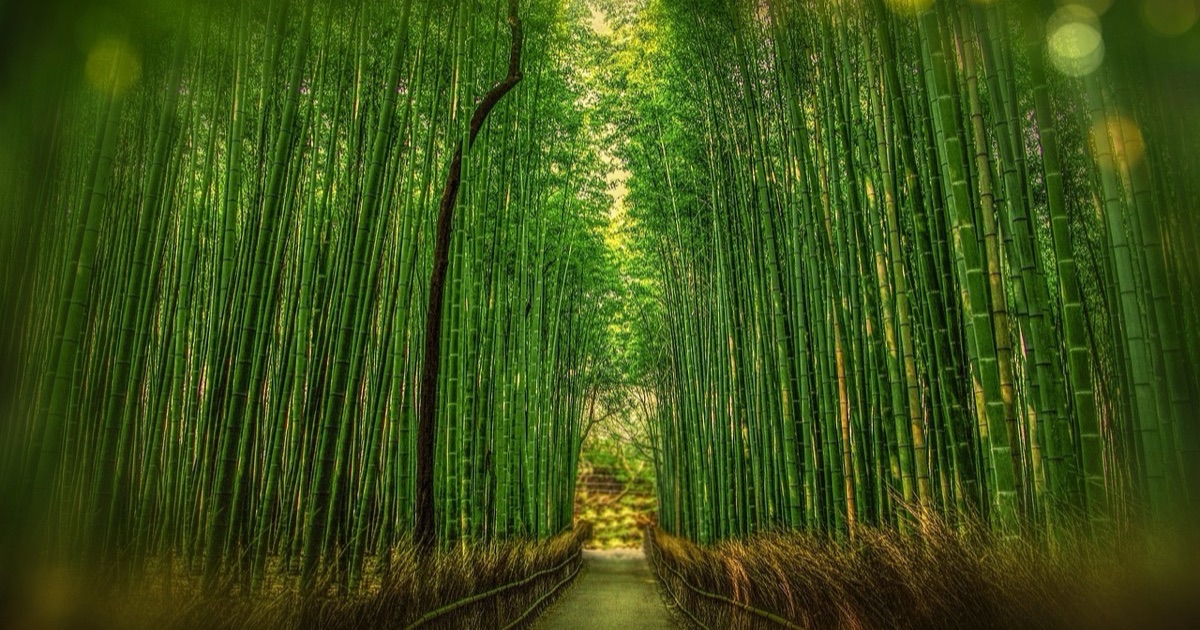
End in the west, at the bridge in Arashiyama. Daikaku-ji's account says it was once called Miyuki Bridge, after Emperor Saga crossed it on his way to worship at Hōrin-ji. In the Kamakura period the Retired Emperor Kameyama watched the moon travel the sky above it and remarked that it resembled the unobscured moon crossing over, and the bridge has been Togetsukyō (渡月橋) since. Cross it after dark and look up; the name does the rest.
Kyoto quiz
3 questionsQ1
In the structure supporting Kiyomizu-dera's Kiyomizu Stage (清水の舞台), what is hardly used to secure the pillars and horizontal beams?
Not quite. The answer is A: “Nails”
According to the official explanation, the pillars and horizontal beams supporting the stage are assembled using traditional joinery, secured with joints and wedges rather than nails. The 13-meter-high stage is supported by 18 keyaki (zelkova) pillars, each 10 meters high and more than 2 meters in diameter. Walk around beneath the stage and look up at how the pillars are fitted together.
Q2
At Kinkaku (鹿苑寺舎利殿), the Golden Pavilion, which story is not covered with gold leaf?
Not quite. The answer is A: “The first story”
According to Kyoto City's official tourism site, Kinkaku consists of the first story, Hōsui-in, in shinden-zukuri (aristocratic residence) style; the second story, Chōondō, in samurai-residence style; and the third story, Kūkyōchō, in Zen Buddhist temple style. Gold leaf is applied over lacquer on the second and third stories. Looking across the pond, compare where the golden surface begins.
Q3
At Nishiki Market (錦市場), known as “Kyoto’s Kitchen,” what rule applies to food you buy?
Not quite. The answer is A: “Eating while walking is prohibited”
At Nishiki Market, eating while walking is prohibited because it can inconvenience other visitors and the shops. Purchased food should be eaten in the shop’s seating area or in front of the shop. Known as “Kyoto’s Kitchen,” the market traces its roots to a fish market that began with the shogunate’s permission in the early Edo period and offers fresh foods and ingredients for Kyoto cuisine. Stop and enjoy what you buy.
Sources
This article is based on the following sources (mostly in Japanese).
- 1.京都駅ビルについて | 京都駅ビル
- 2.ニデック京都タワーについて | ニデック京都タワー
- 3.京都府の住所表記のなぞ - 右が左京区で左が右京区? 「上ル」「下ル」?
- 4.知っているかな?京の通り名 | きょうとこども情報館 | 京都市
- 5.京都の難読地名、帷子ノ辻には着物が関係する悲しい逸話が残っていました
- 6.京都の難読地名には古都ならではの歴史あり。その由来について調べてみた
- 7.どれくらい分かる? 京都人がよく使う京ことば40選
- 8.1903年の京都語1~助動詞「どす」
- 9.清水寺の舞台裏 | 音羽山 清水寺
- 10.五重塔 | 東寺
- 11.祇園祭「どんな祭?」|【京都市公式】京都観光Navi
- 12.蓮華王院<三十三間堂> | 京都市公式 京都観光Navi
- 13.文化史10 銀閣寺(慈照寺) | 京都市
- 14.水路閣 | 見どころ | 日本遺産 琵琶湖疏水
- 15.南禅寺発祥の湯豆腐を名庭を眺め味わう|南禅寺 料庭八千代
- 16.鹿苑寺(金閣寺) | 京都市公式 京都観光Navi
- 17.境内と建造物 | 観る|お西さん(西本願寺) 参拝案内
- 18.紫宸殿 | 京都御所 | 宮内庁
- 19.高御座 -古代より継承されてきた特別な御座- | 京都御所 | 宮内庁
- 20.社殿・境内案内 | 平安神宮
- 21.時代祭「どんな祭?」|【京都市公式】京都観光Navi
- 22.葵祭「どんな祭?」|【京都市公式】京都観光Navi
- 23.千本鳥居 | 伏見稲荷大社スマホサイト
- 24.上賀茂神社 第42回式年遷宮 | 賀茂別雷神社
- 25.京都五山送り火「どんな行事?」|【京都市公式】京都観光Navi
- 26.京都の名物料理「にしんそば」を徹底研究。なぜにしんが蕎麦にのっているの?
- 27.京都名物『にしんそば』とは?発祥や京都で生まれた理由、美味しい食べ方を紹介!
- 28.鯖寿司とは?歴史やオススメの名店など
- 29.鯖街道とは
- 30.京都三大漬物とは?しば漬け・千枚漬・すぐきの特徴や違いをわかりやすく解説
- 31.ちょっとマイナー?千枚漬け・しば漬けと並ぶ「京都の三大漬物」すぐき漬け
- 32.伝えたいのは質素倹約、工夫や感謝など、おばんざいにこめられた人の温もりという隠し味。
- 33.【京都】錦市場の食べ歩き12選!おすすめグルメをマップ付きで紹介<2025>
- 34.八つ橋の生と焼きの違いとは?京料理 本家たん熊が教える本物の楽しみ方
- 35.統計トピック2 家計調査からみる京都市民のすがた(食料編)
- 36.なぜ?パン消費量日本一の京都 地元人気ベーカリーに理由を聞いてみた
- 37.京都市、コーヒー支出額トップ おもてなし文化が背景?
- 38.ほっとコーヒータイム(115)コーヒー消費量No.1は京都市
- 39.イノダコーヒ本店|【京都市公式】京都観光Navi
- 40.一保堂茶舗 京都本店/喫茶室 嘉木
- 41.地下鉄のあゆみと概要 | 京都市交通局
- 42.展望列車「きらら」 | 叡電を知る
- 43.渡月橋は嵯峨天皇の御幸橋 | 旧嵯峨御所 大本山 大覚寺
This article was put together with the help of AI from facts confirmed in its sources, and checked against those sources before publication. See our editorial policy for details.