Hiroshima, Hiroshima Prefecture
Hiroshima on Foot: Carp, Streetcars and the Axis Line
A walk through Hiroshima: the cenotaph's axis line to the Atomic Bomb Dome, streetcars still running since 1945, Carp Castle, and what soba means here.
Published 38 sources
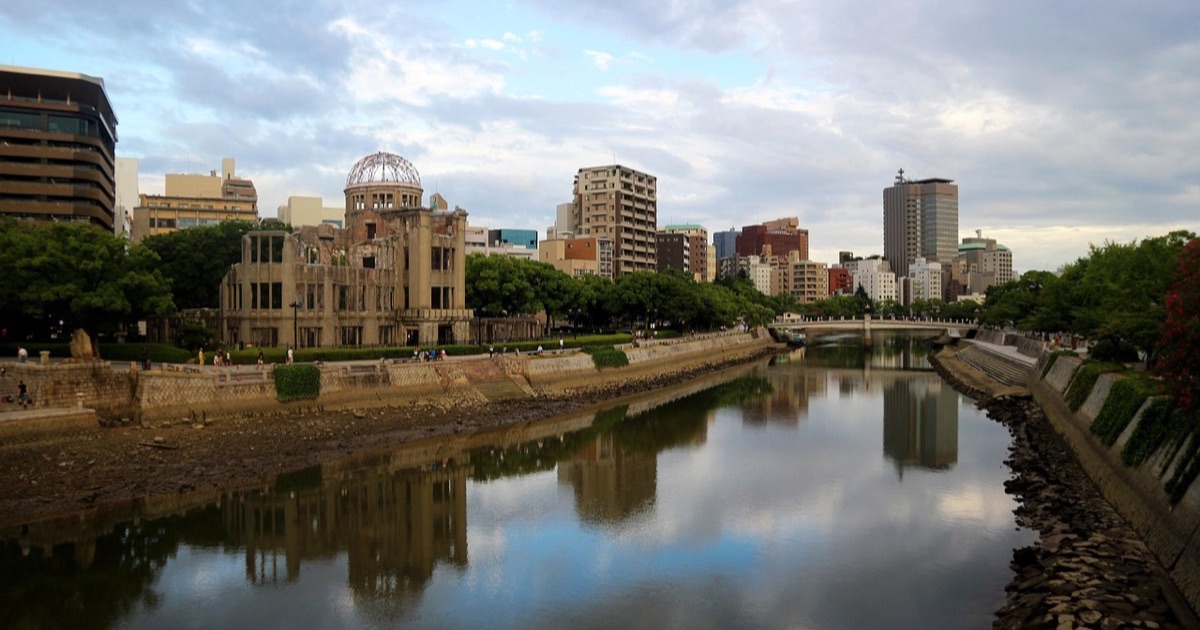
The building that draws every camera in Hiroshima began as a showroom for local goods. The Hiroshima Prefectural Products Exhibition Hall (広島県物産陳列館) was designed by the Czech architect Jan Letzel (ヤン・レツル) and completed on 5 April 1915: a Western-style, three-story brick structure with some steel framing, a five-story stairwell at the center of its façade, and above that an oval dome of copper plate. In 1933 it was renamed the Hiroshima Prefectural Industrial Promotion Hall. What stands there today, the Atomic Bomb Dome (原爆ドーム), is the frame of that stairwell and the skeleton of that oval dome.
Keeping it was not a given. After the bombing, opinion was divided between preserving the ruin and demolishing it, and the voices for preservation grew until the first preservation project went ahead in 1967. Three more followed, in 1989, 2002 and 2015 — four in all. Look for the reinforcing steel and the wires worked into the brickwork; they are part of why there is still something to look at. In December 1996, at a World Heritage Committee session held in Mexico, the dome was placed on the World Heritage list.
Standing on the Axis Line
Peace Memorial Park (平和記念公園) is organized around a line you can stand on. From Peace Boulevard (平和大通り) the axis runs through the Peace Memorial Museum and on to the dome, and the cenotaph sits in the middle of it. The water basin set behind the monument is there to keep people from stepping onto that axis. Kenzo Tange (丹下健三) designed the park as a whole. The first cenotaph was reinforced concrete; the one standing now repeats the same shape in granite. The park was designated a national Place of Scenic Beauty on 6 February 2007.
One building at the park's edge is older than the park. It was put up as the Taishoya Kimono Shop (大正屋呉服店), a reinforced-concrete structure, and in 1944 it was bought by the prefectural fuel distribution association. It stood 170 meters from the hypocenter. The city's record is plain: the roof was wrecked, the interior destroyed and burned, and everyone inside died except one person who was in the basement. Repaired after the war, it housed the Hiroshima Eastern Reconstruction Office in 1957, and serves now as the Peace Memorial Park Rest House.
That building has a second life on screen. The animated film In This Corner of the World (この世界の片隅に) sets part of its story in Nakajima-honmachi (中島本町), the district the park now covers, and reconstructs the streets as they were before the bombing. A newsletter from the Hiroshima Peace Memorial Museum (広島平和記念資料館) describes an exhibition built around the film and the Nakajima neighborhood where its protagonist, Suzu, lived, and records that the shopfront of Otsuya Moslin-do (大津屋モスリン堂), of which no photograph survives, was pieced together from interviews and drawn more than ten times over.
North of the museum's East Building stands a Chinese parasol tree, aogiri (アオギリ), that was in the city that morning. It grew in the courtyard of the Hiroshima Communications Bureau (広島逓信局), about 1.3 kilometers from the hypocenter. Heat rays and blast left it like a dead stump, but the next spring it put out new shoots, which is said to have given hibakusha — the people who lived through the bombing — courage to keep going. In May 1973 it was transplanted to where it stands now. One side of the trunk still carries the scar.
The Cars That Went Back to Work
Hiroshima's streetcars are not a heritage attraction. They are how people get to work, and they were here for it. Hiroshima Electric Railway (広島電鉄) owned 123 cars when the bomb fell. According to the city's records, 108 of them were damaged and 185 employees died. A Type 150 car, parked near Eba (江波), was left moderately damaged. Ride a line today and the route map is also a map of that morning.
Service came back quickly. The city's account records a shuttle running again between Koi (己斐) and Nishi-Tenmacho (西天満町) on 9 August, three days after the bombing, and the full run between Koi and Hiroshima Station reopening on 11 October. Five Type 650 (650形) cars were originally built and four survive, having kept their form through 6 August 1945. No. 651 and No. 652 still work regular passenger service, so an ordinary errand can put you aboard one. No. 654 is kept at the Numaji Transportation Museum (ヌマジ交通ミュージアム), its interior opened to visitors roughly once a month.
No. 653 took heavy damage near the Eba district on 6 August 1945, and was repaired and back in service four months later. It kept running through the city until it retired in 2006, and for the seventieth anniversary of the bombing in 2015 it was repainted in the livery it wore in 1945. It goes out now in summer as a chartered event car. Passing the Eba depot, look toward the back of the yard.
Carp Castle, and the Name It Gave Away
Hiroshima Castle (広島城) has a second name: Rijo (鯉城), Carp Castle. Where it came from is unsettled. The castle's own newsletter offers one theory — that the area around the castle was once called Koi-no-ura (己斐浦), and that the name shifted from there into Rijo — while stating that there is no proof. It also notes that the late-Edo Confucian scholar Rai Itsuan (頼聿庵) wrote the words Rigyojo (鯉魚城) and Rijo, so the nickname seems to have been in use at least by his time. West of the inner moat, across Route 54 in Chuo Park (中央公園), a carp sculpture called Hiyaku (飛躍) answers to it.
The nickname outlasted the castle's working life. The baseball team that plays in this city is the Hiroshima Toyo Carp (広島東洋カープ), and Carp — English for koi — is taken from the castle's other name. One account of the naming adds the Ota River (太田川), which runs through Hiroshima and was known as carp-producing water. Visit the keep before a game and the team's name stops sounding arbitrary.
Koi itself carries a story. Local legend, as retold in a travel feature on the place name, holds that Empress Jingu (神功皇后) arrived at Koi, climbed Mt. Matsu (松山), also called Asahiyama (旭山), and while resting there was moved by the sight of a black carp — a moment said to have given the district its name, a homophone of koi. The same account traces the name's origins to around 190–200 CE. You will see Koi on streetcar destination boards.
Baseball here comes with a walk. The club's own description of Mazda Stadium (マツダスタジアム) notes that the concourse sits at the back of the first-level seating and is built without steps — 12 meters wide behind the infield, 8 behind the outfield — and lined with concession stands and restrooms. Because the field stays in view from the concourse, you can walk the whole loop, about 600 meters, without losing the game. Leave your seat mid-inning and try it.
The football club carries a different kind of family story. Akitakata City's (安芸高田市) official page explains that the name Sanfrecce Hiroshima comes from Mori Motonari's (毛利元就) Lesson of the Three Arrows (三矢の訓), a teaching he is said to have given his three sons. Because of that connection the players travel each year to Kiyo Shrine (清神社) in Yoshida-cho — a shrine being a place of worship in Japan's indigenous Shinto religion — to pray for victory.
Shutters, Granite, and a Hall That Came From Yamaguchi
Fukuromachi (袋町), in Naka Ward (中区), holds a bank that stayed standing. The former Bank of Japan Hiroshima Branch (旧日本銀行広島支店) moved into its new building here in September 1936, 380 meters from the hypocenter. On the first and second floors the iron shutters had been closed, which spared those interiors from severe damage; the third floor, left open, burned out completely, and twenty people inside the building died. The city designated it an Important Tangible Cultural Property in 2000, and it is open to the public. Compare the floors with your own eyes.
Hiroshima University's old science faculty building (広島大学旧理学部1号館) stood 1,420 meters from the hypocenter and burned out, leaving only its outer shell. Classes resumed there in earnest in September of the following year. It had been completed in 1931 as a school building of Hiroshima University of Literature and Science (広島文理科大学), and a later reform of the education system brought it under Hiroshima University. The city says it is preserving the building as an A-bombed structure while using it as a base for peace education and research. The shell is the thing to look at.
Hiroshima's single National Treasure building stands at the foot of a mountain. Fudoin (不動院) keeps a precinct there, and its Kondo (金堂), the main Buddhist hall, is said to have begun as the Buddha hall of Kojaku-ji in Yamaguchi (山口), founded by the Ouchi clan (大内氏), before Ankokuji Ekei (安国寺恵瓊) had it moved here during the Azuchi-Momoyama period. A project documenting National Treasures explains that the hall escaped the bomb's damage because of that position below the hills, and calls it the only National Treasure building left in the city; the prefecture's building guide calls its survival of the war miraculous. Stand under the great roof and the geography explains itself.
Shukkei-en (縮景園) was a lord's garden before it was anyone else's. Its official history says that Asano Nagaakira (浅野長晟), the first lord of the Hiroshima Asano domain, began building it in 1620 as the garden of his villa, and that the work was done by Ueda Soko (上田宗箇), a chief retainer also known as a tea master. People called it Osensui, or Sentei, in those days. The name it carries now is said to come from a line in the preface of a poem that the Confucian scholar Hayashi Razan (林羅山) wrote at the request of the second lord, Asano Mitsuakira (浅野光晟): mountains and seas condensed into this place, the scenery gathered into this pavilion.
The garden's chronology makes the next part short. The Asano family gave it to Hiroshima Prefecture in 1940, and in July of that year it was designated a Place of Scenic Beauty. Five years later, on 6 August 1945, the bomb left it close to totally destroyed: buildings in ruins, great old trees burned, lives lost inside the walls and outside them. The Takueiike pond (濯纓池), the artificial hills and the Koko-kyo bridge (跨虹橋) were badly damaged but held their old form. Restoration began in 1949 and took about thirty years to finish.
For a building of another era, climb Hijiyama (比治山). The Hiroshima City Museum of Contemporary Art (広島市現代美術館), designed by the architect Kisho Kurokawa (黒川紀章), opened in the park up there in 1989, and the museum explains its exterior as a vertical sequence: natural stone at the base, then tile, then aluminum near the top, standing for the development of civilization and the passage of time from past to future. On the way up, watch for the heights where one material gives way to the next.
What "Soba" Means on a Hiroshima Griddle
Order okonomiyaki — a savory pancake cooked on a flat iron griddle — in Hiroshima and you will meet the phrase niku-tama soba (肉玉そば). The name stacks three words: meat, egg, soba. The soba is not buckwheat. It is yakisoba, the fried wheat noodles, layered into the pancake. Mitchan Sohonten (みっちゃん総本店) tells the story on itself: the founder put okonomiyaki on top of yakisoba at his stall, and customers approved because it filled you right up. That dish, soba niku-tamago, is said to be where today's standard came from. Sit at the counter and watch the noodles go in.
If deciding is the hard part, there is a building for that. Okonomimura (お好み村) in Naka Ward is a single building whose floors are filled with okonomiyaki restaurants, grill beside grill. Its own history traces it to the food stalls that gathered in the Shintenchi (新天地) plaza after the war; the stalls became a two-story prefab, and the prefab eventually became the high-rise standing there now. Take the stairs and enjoy the problem.
The city's noodles go further than that. In Funairi (舟入), the soupless tantanmen (汁なし担担麺) at Kisaku (きさく) — a chili noodle dish served without broth — is built on a sauce made spicy with chili oil and fermented black bean paste, into which a little stock of dried sardine, kelp and chicken bone goes; reporting on the shop says the owner went to Sichuan on an impulse and ate through dozens of places there to work out the flavor. Hiroshima tsukemen is a separate habit: noodles and dipping sauce both served cold, the soy-based sauce cut with chili oil, chili pepper, vinegar and sesame, vegetables piled until the noodles vanish, heat chosen from seven steps.
Two things for the bag home. Gansu (がんす) is battered, deep-fried fish paste descended from kamaboko, the steamed fish cake; an article from Mizkan's Water Culture Institute notes that people in Hiroshima itself once asked what gansu was, and that it now turns up on school lunch menus. Look in the deli case. The other is momiji manju, the maple-leaf-shaped cakes sold as souvenirs here: Nishikido (にしき堂) describes its Nama Momiji (生もみじ) as a chewy, moist, fresh-confection version, made with rice flour from Hiroshima Prefecture and azuki beans from Hokkaido, and developed from hints in customer feedback. Eat one beside a classic and the difference is in the texture.
Paper, a Filled-In Moat, and the Sideways River
The names of the central districts are receipts for older business. One account researching local place names, citing the Hiroshima City History (広島市史), records that a merchant called Iyoya Kurozaemon moved here from Iyo province on Shikoku in 1591 and started a paper trade, and that Kamiyacho (紙屋町) — kami, paper — took its name from him; the same account notes he was later put in charge of the domain's exchange. Kamiyacho is the streetcar hub at the center of the city now. Read the stop names as you pass through.
Hatchobori (八丁堀), a downtown shopping district, was water. Local archive material explains that it was the outer moat on the east side of Hiroshima Castle, and that the name is accounted for in two ways: either the moat itself ran eight cho — about 900 meters — or it led to Hatchobamba, a residential quarter of mid-ranking samurai of that same length. The moat was filled in when the streetcar lines were laid. The shopping streets you walk are its bed.
Yokogawa (横川) is named for a direction. A local broadcaster's explainer points out that where the Hon River (本川) branches off into the Tenma River (天満川), that stretch is the one part running east to west — yoko, sideways — and that standing beside it is how the area came to be called Yokogawa. Find a bridge nearby and check the current for yourself.
You will hear the city before you parse it. Hiroshima Prefecture's own dialect guide glosses jakee (じゃけえ) as the local form of dakara — because, so — and lists etto for a lot, inuru for going home, and neki for nearby. Two more are worth carrying: habuteru is to sulk or pout, and taigii means troublesome, draining, more effort than you have left. Say "taigii nou" at the end of a long day of walking and nobody will ask where you picked it up.
Yukata Weather and a Boulevard in Bloom
Early summer has its own signal. The official site of the Tokasan festival explains that Inari Daimyojin (稲荷大明神) was enshrined at Enryuji (圓隆寺) in 1619, the year the temple was built, and that the festival began in the fifth month of 1620 and has continued for about four hundred years. It is known affectionately as the festival for the first wearing of yukata, the light cotton summer kimono, and on festival days the streets fill with them. The site says the area around the temple on Chuo-dori draws 450,000 people a year.
Spring has the other one. In 1975 the Hiroshima Toyo Carp won their first league championship, and the victory parade along Peace Boulevard drew such crowds that residents began asking for a festival anyone could join; the first Hiroshima Flower Festival followed in 1977, organized around the Chugoku Shimbun, and 1.25 million people came over its three days. The boulevard it fills is where the axis begins — the line that runs through the museum to the dome, with the cenotaph in the middle and the water behind it holding everyone off. Walk that line in either direction and the city says the same thing twice.
Hiroshima quiz
3 questionsQ1
The cenotaph at Peace Memorial Park (平和記念公園) — why is there a water basin behind it?
Not quite. The answer is A: “To keep people from stepping onto the axis line”
The cenotaph sits on the axis running from Peace Boulevard, through the Peace Memorial Museum, to the Atomic Bomb Dome (原爆ドーム). The water basin behind it keeps people from stepping onto that axis line. Kenzo Tange (丹下健三) designed the whole park; the cenotaph's original reinforced-concrete form was later remade in granite, in the same shape, as the version standing today. Stand in front of it and see whether the dome lines up beyond.
Q2
What is the name "Carp" in the Hiroshima Toyo Carp (広島東洋カープ) baseball team named after?
Not quite. The answer is A: “Hiroshima Castle's alternate name, "Rijō" (鯉城)”
The team's name carries "Carp," English for 鯉 (koi), said to be a nod to Hiroshima Castle's (広島城) alternate name, "Rijō" (鯉城, "Carp Castle"). In other words, the castle's old nickname became the team's name outright. Look up at the castle keep before heading to the stadium, and the red uniforms' carp emblem may look a little different afterward.
Q3
In Hiroshima's classic okonomiyaki style 'niku-tama soba' (肉玉そば), what does the 'soba' actually refer to?
Not quite. The answer is A: “Yakisoba noodles”
According to Mitchan Sohonten's (みっちゃん総本店) official account, the shop once placed okonomiyaki on top of yakisoba noodles, and customers loved that it 'filled you right up.' Called 'soba niku-tamago,' this dish is said to be the origin of today's classic 'niku-tama soba.' Sit at the griddle and watch the yakisoba noodles get layered in.
Sources
This article is based on the following sources (mostly in Japanese).
- 1.原爆ドーム(旧広島県産業奨励館) - 文化遺産オンライン
- 2.原爆ドーム(広島県物産陳列館) - 広島ピースツーリズム(広島市経済観光局運営)
- 3.arch-hiroshima 平和記念公園慰霊碑
- 4.平和記念公園 - 広島ピースツーリズム(広島市経済観光局運営)
- 5.平和記念公園レストハウス - 広島市公式ウェブサイト
- 6.機関紙「平和文化」No.204-6 資料展「この世界の(さらにいくつもの)片隅に - 広島のすずさん展」
- 7.アオギリ(被爆アオギリ) - 広島市公式ウェブサイト
- 8.被爆電車 - 広島市公式ウェブサイト
- 9.あの日を知る被爆電車653号 - 平和記念公園レストハウス公式
- 10.しろうや!広島城 No.9(広島城 広報紙)
- 11.広島城、別名「鯉城」はカープの由来 - 中国新聞デジタル
- 12.プロ野球チーム「広島東洋カープ」/ホームメイト
- 13.【難読地名】「己斐」って読めますか?広島市の西側に位置する、西国から城下への玄関口
- 14.マツダスタジアム コンコースマップ - 広島東洋カープ公式サイト
- 15.サンフレッチェ広島 | 安芸高田市
- 16.旧日本銀行広島支店の沿革 - 広島市公式ウェブサイト
- 17.広島大学旧理学部1号館の保存・活用 - 広島市公式ウェブサイト
- 18.不動院 - ひろしまたてものがたり(広島県公式)
- 19.不動院 - 国宝を巡る旅
- 20.縮景園の歴史 - 縮景園公式サイト(広島県立美術館)
- 21.縮景園 - 徹底解剖!ひろしまラボ(広島県公式)
- 22.広島市現代美術館 公式サイト
- 23.お好み焼きの歴史|お好み焼みっちゃん総本店
- 24.【広島お好み焼き特集】その歴史は半世紀以上 老舗店が伝え続けた味
- 25.お好み村とは|元祖広島お好み焼「お好み村」ホームページ
- 26.広島の汁なし担担麺のお店『汁なし担担麺 きさく』が初登場!
- 27.本場四川省の味が楽しめる「きさく」
- 28.「また食べたい」を誘う辛さ! 元祖の流れを汲む広島つけ麺の名店へ
- 29.かまぼこ由来の練り物フライ がんす(機関誌『水の文化』74号)
- 30.広島新銘菓 生もみじ|商品情報|広島菓子処 にしき堂
- 31.シリーズ:絵葉書から辿る① 紙商売から名付けられた「紙屋町交叉点」のかつての姿
- 32.4:商業地の発展、通りと街の整備 ~ 広島 | このまちアーカイブス
- 33.【広島雑学】横川にはへぇ~がいっぱい 地名の由来は川の流れ方
- 34.広島県の方言 | 広島県
- 35.方言が伝わらなかった話(66) 【漫画】広島弁「たいぎい」とは?
- 36.お祭りの歴史 – とうかさん公式Webサイト
- 37.2024ひろしまフラワーフェスティバルとは?歴史や魅力、開催日程を紹介!
- 38.「ひろしまフラワーフェスティバル」5月3日から 昨年は160万人が来場
This article was put together with the help of AI from facts confirmed in its sources, and checked against those sources before publication. See our editorial policy for details.